
What Nearly $1M Actually Buys in the Triangle
Saira Bruno September 13, 2026
Saira Bruno September 13, 2026
I'm Saira Bruno, and I have some version of this conversation almost every week with buyers relocating to the Triangle: they've seen the headline that the median home price here is around $400K, they've built a budget around it, and then they start touring and the math stops working. I want to walk you through why that happens, and what the number should actually look like for what you're trying to buy — before you fall in love with a house you can't get comps to justify, or worse, talk yourself out of a great one because it "seems expensive" for the area.
If you'd rather skip straight to the conversation, book a consult with me directly — the rest of this is exactly what I'd walk you through in that first call anyway.
Here's the thing about that $400K–$450K median: it's an average of everything that sold — 1,200 sq ft townhomes in Garner blended in with custom estates in North Raleigh, homes built last year next to homes built in 1975, all 19+ cities lumped into one number. It's not wrong. It's just answering a completely different question than the one you're actually asking.
The question you're actually asking is something closer to: if I want a great school district, real square footage, a yard that isn't shared with three other units, and a house that doesn't need a renovation the week I move in — what does that actually cost, and where?
I can tell you the honest answer up front: it starts closer to $800K, and depending on how close to town you want to be, it climbs from there toward $1M and beyond. That's not me padding a number to justify a bigger commission — it's what I see close, over and over, for buyers with your priorities.
Find your neighborhood match with our quiz tool.
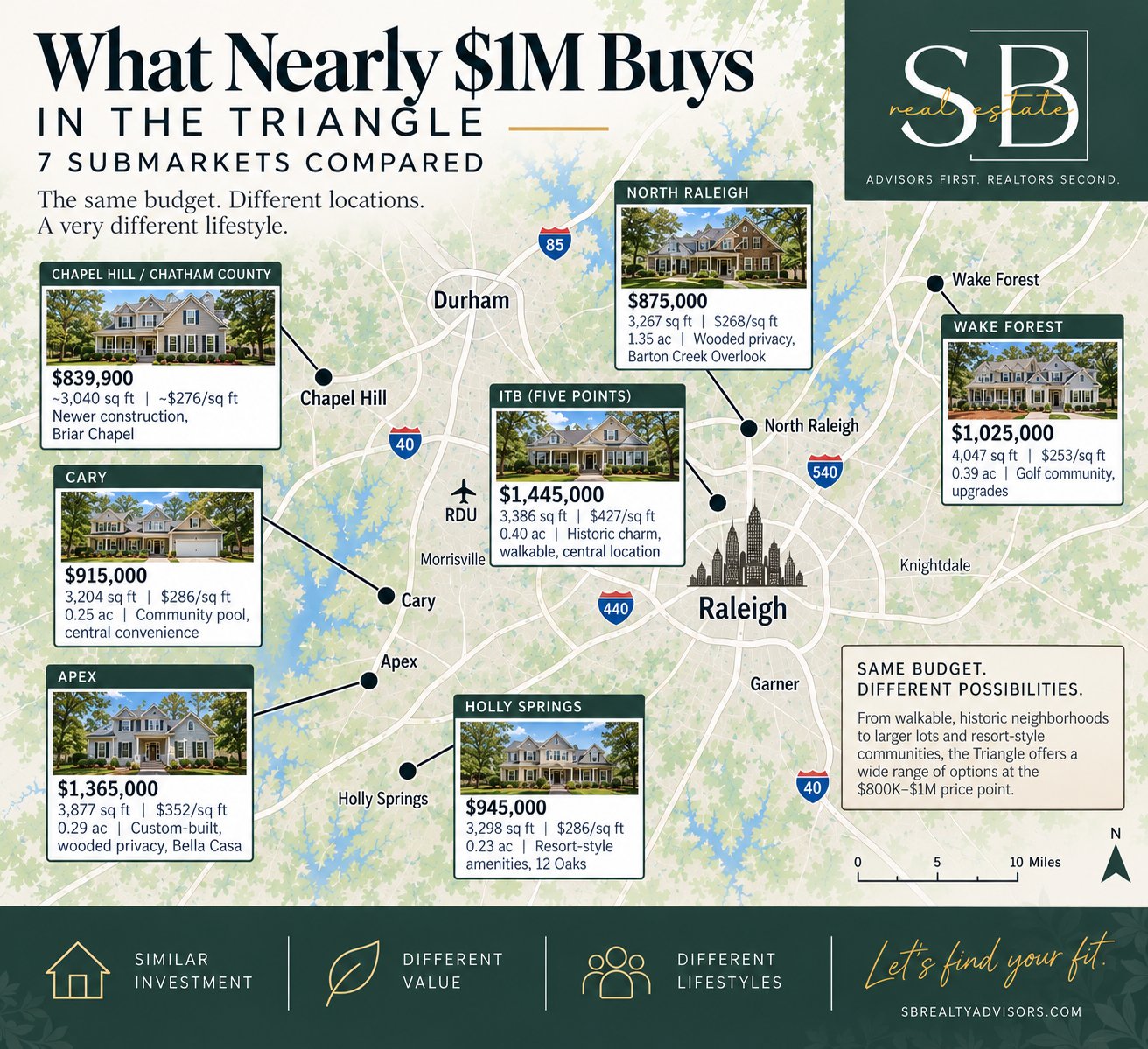
I pulled real listings currently under contract — not averages, not estimates — across seven submarkets, all landing in a similar 3,000–4,000 sq ft range, so you're comparing apples to apples on size. Here's what nearly $1M actually gets you depending on where you point it:
Submarket | Address | Sq Ft | Price | $/Sq Ft | Lot | What Stands Out |
|---|---|---|---|---|---|---|
ITB (Five Points, Raleigh) | 2501 Kenmore Dr | 3,386 | $1,445,000 | $427 | 0.40 ac, corner | 1928 historic charm, walkable, zoned for Joyner Elementary and Broughton High |
North Raleigh | 5704 Wild Orchid Trl | 3,267 | $875,000 | $268 | 1.35 ac, wooded | Deep privacy on a 1.3-acre lot, Barton Creek Overlook |
Cary | 710 Magalloway Dr | 3,204 | $915,000 | $286 | 0.25 ac | Community pool/clubhouse, central Cary convenience |
Apex | 2400 Chianti Ct | 3,877 | $1,365,000 | $352 | 0.29 ac, cul-de-sac | Custom-built, wooded privacy, Bella Casa |
Holly Springs | 828 Rambling Oaks Ln | 3,298 | $945,000 | $286 | 0.23 ac | 12 Oaks golf community, resort-style amenities |
Wake Forest | 7500 Hasentree Way | 4,047 | $1,025,000 | $253 | 0.39 ac | Golf course community, $200K+ in recent upgrades |
Chapel Hill (Chatham Co.) | 248 Logbridge Rd | ~3,040 | $839,900 | ~$276 | Briar Chapel | Newer construction, established master-planned community |
Look at ITB versus Wake Forest for a second. Nearly double the price per square foot — for less house and a smaller lot. That's not a fluke in the data. That's the actual price tag on being close to town. Every submarket in between is you buying back some of that centrality, dollar by dollar, in exchange for more land and often a newer house.
If you're trying to figure out which side of that trade-off is right for your family, that's precisely what my Neighborhood Match tool is built to sort through — a few minutes of questions about how you actually want to live, matched against the submarkets that fit, instead of a scattershot search across all 19 cities.
When I sit down with a buyer and we start comparing houses like the ones above, the address is rarely what decides it. It's usually one of these five things:
None of this shows up in a median price, and most of it doesn't show up clearly online either. This is the part of the search where having someone who's actually walked these specific streets pays off — it's a conversation, not a filter. Set up a consult with me and we'll go through your specific list before you burn a weekend touring houses that were never going to fit.
This is the real question underneath everything above, and it's the one I ask every relocating buyer directly. It's not about whether you can get to a grocery store — you can, almost everywhere in the Triangle, within a few minutes. It's about how much distance you're willing to put between yourself and the specific places and people that matter to you.
Centrally located neighborhoods buy you flexibility — school choice, shorter drives to more of what you care about, proximity to the spots that come up most when people talk about "living in Raleigh." Suburban markets buy you space, privacy, and often a newer house for less per square foot — with a longer drive to some of those same places.
I won't tell you one is right. I will tell you that the buyers who are happiest a year in are the ones who answered this question honestly before they started touring, not after they made an offer.
This exact comparison — pulling real listings, walking through the trade-offs, pressure-testing what actually matters to a specific family — is the work I do before a client ever steps into a showing. About 30% of my business is new construction and custom builds, so I spend as much time evaluating lot placement, builder quality, and floor plans as I do comparing neighborhoods. I built my business around a simple idea: advisors first, realtors second. My job isn't to get you into a house. It's to get you into the right one, for the reasons that are actually yours.
I've closed 135+ homes totaling nearly $78M across 19 Triangle cities, and I've had this exact conversation — median price versus real cost, centrality versus space — often enough that I can also connect you directly with clients who've made this same move, so you're not just taking my word for any of this.
How do you find the house where you want to be — and how do you know it's actually the right place once you're there? That's the question I help relocating buyers answer, every week. Two easy next steps:
Is $400K a realistic budget for a luxury home in Raleigh? No — and I'll tell you that in the first five minutes if you ask me. $400K is closer to the Wake County median across all home types and ages. If you want an updated, well-located home with strong school access, budget $800K and up, with the exact number shifting based on submarket and how centrally located you want to be.
What does $800K–$900K buy in Cary vs. Wake Forest? In Cary, that budget typically buys around 3,000–3,200 sq ft on a smaller, HOA-managed lot with community amenities. In Wake Forest, the same budget can stretch to 4,000+ sq ft with a larger lot, often in a golf or amenity-rich community — but with a longer drive to central Raleigh.
How much does being Inside the Beltline (ITB) cost compared to the suburbs? Based on current comparable listings, ITB homes run roughly $400+ per square foot, compared to $250–$290 per square foot in Cary, Apex, Holly Springs, and Wake Forest — nearly double, for typically less square footage and smaller lots.
Does moving to the suburbs mean a long commute to everything? Not for daily needs — groceries, pharmacies, and basic errands are within a few minutes almost everywhere in the Triangle. The trade-off shows up specifically in drive time to certain employment hubs, downtown venues, and the amenities people most associate with "living in Raleigh."
I am REAL & easy to reach! Call me: 919-614-2436 or email [email protected]
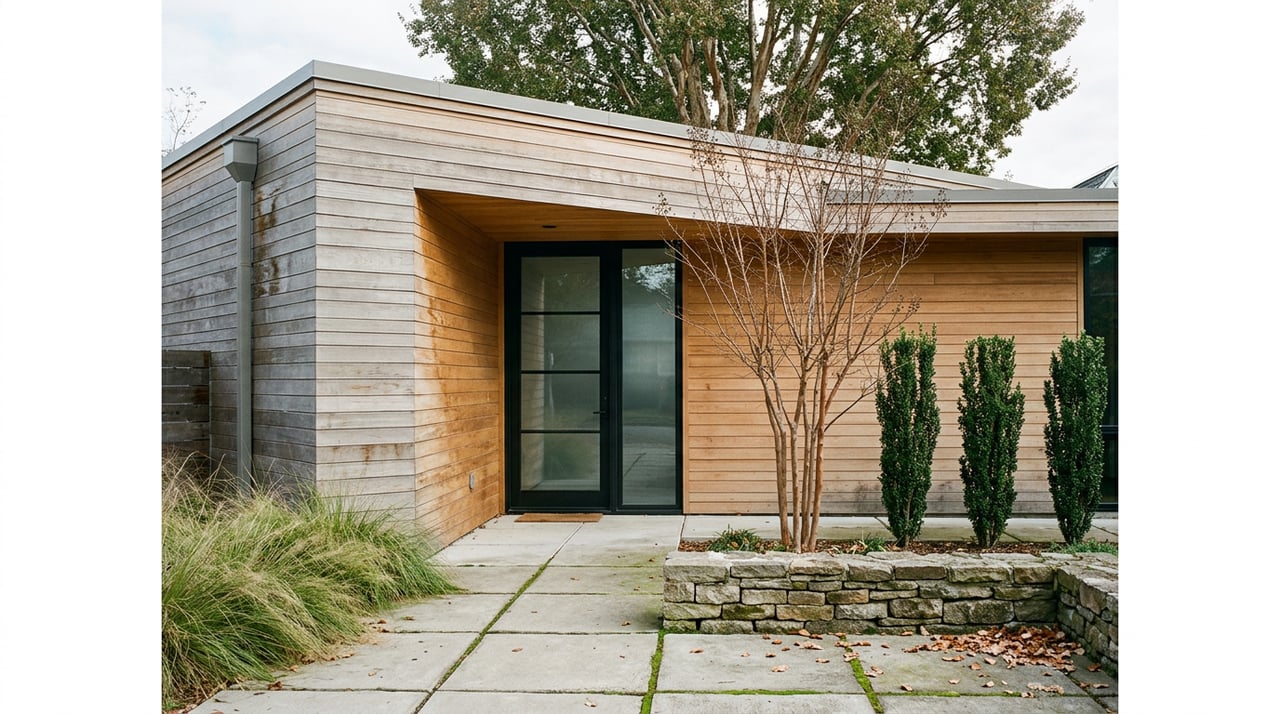
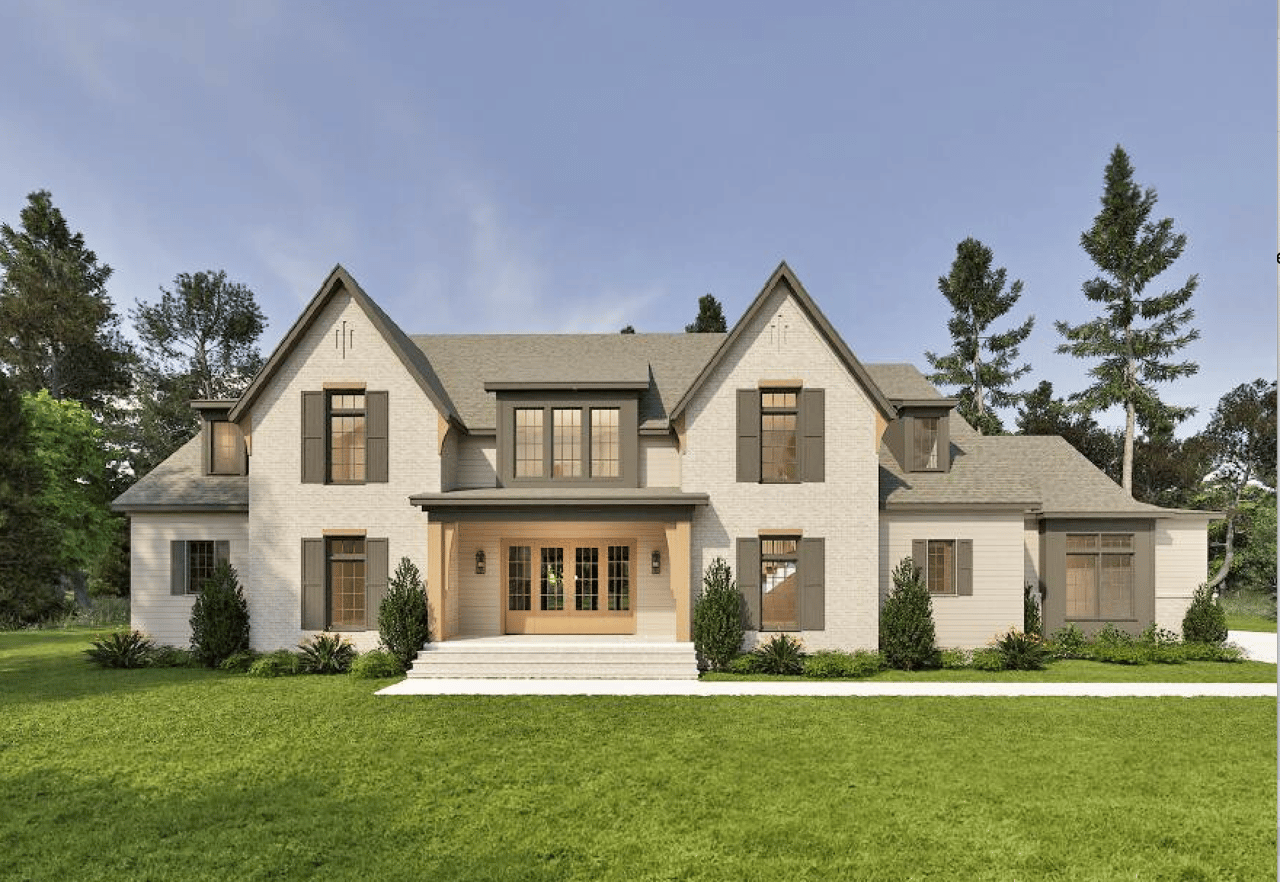
What $2 million buys in Raleigh, which luxury neighborhoods and builders to explore, and why the right strategy matters before you tour the 2026 Triangle Parade of Hom… Read more
7 Submarkets Compared
If you’ve been renting in Raleigh or the Triangle since 2020, the question may not be whether you missed your chance to buy. It may be what waiting for the “right” mar… Read more


Has the Raleigh Housing Market Cooled?

At SB Real Estate, we help luxury buyers evaluate not only whether they love a property, but whether the price, condition, location and long-term value make sense.
We pride ourselves in providing personalized solutions that bring our clients closer to their dream properties and enhance their long-term wealth. Contact us today to find out how we can be of assistance to you!