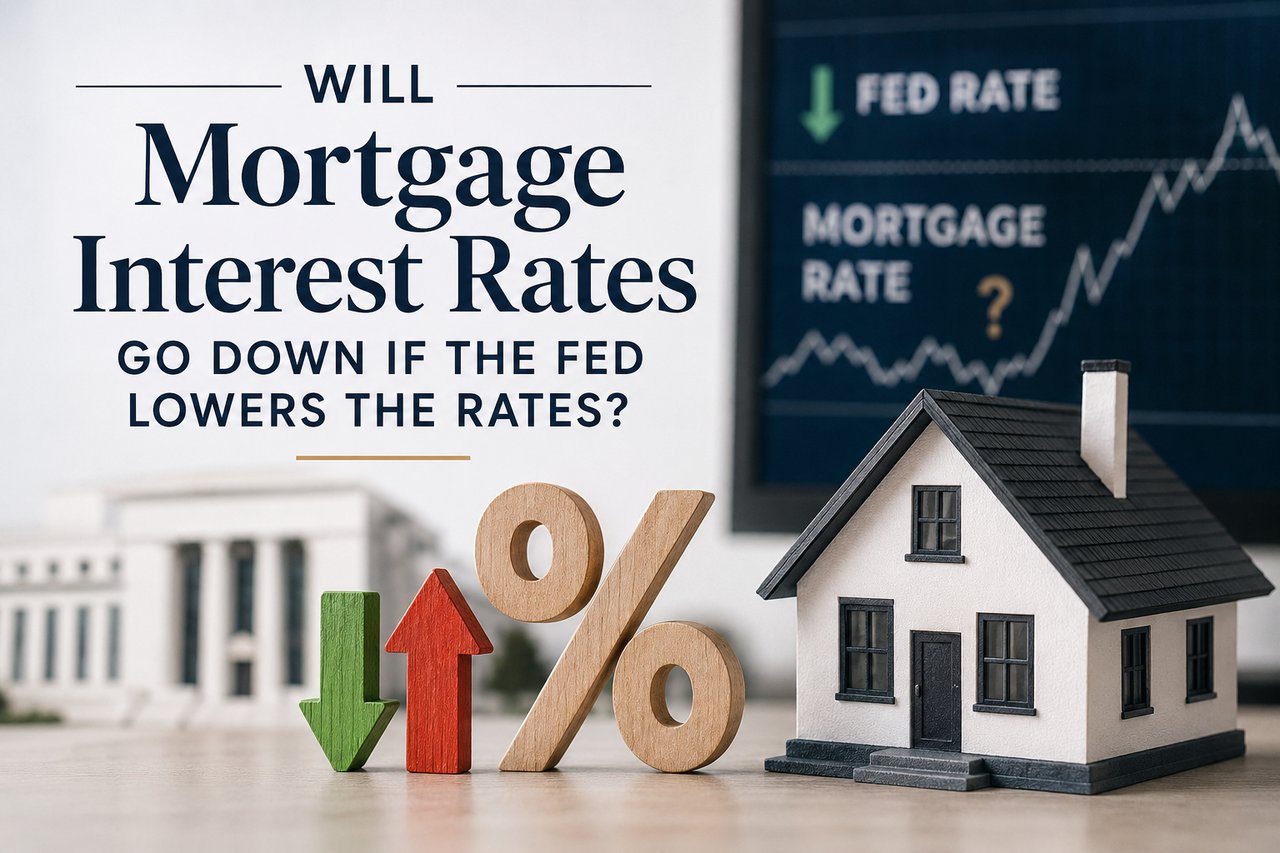
Will Mortgage Interest Rates Go Down If the Fed Lowers Rates?
Gina Wright August 17, 2026
Gina Wright August 17, 2026
If you’ve been paying attention to the news lately, you’ve probably heard a lot about the Federal Reserve and whether it will lower interest rates.
And if you’re thinking about buying a home, you may be wondering:
“If the Fed lowers rates, does that mean my mortgage rate will automatically go down, too?”
It’s a very reasonable question.
Unfortunately, the answer is not necessarily.
This is one of those areas where the headlines can make things sound much simpler than they actually are. So let’s break it down.
Schedule a time to chat with me!
This is the most important thing to understand.
The Federal Reserve, often called the Fed, sets the federal funds rate. This is the short-term interest rate banks charge one another for overnight lending.
Mortgage rates are different.
Thirty-year fixed mortgage rates are influenced much more heavily by long-term bond markets, particularly the 10-year Treasury yield, along with inflation expectations, economic growth, investor demand, and the overall risk associated with mortgage lending.
So when you hear:
“The Fed cut interest rates today!”
That does not automatically mean your lender will call you tomorrow and say, “Congratulations! Your 30-year mortgage is now cheaper.”
I wish it worked that way. It would certainly make my job easier.
Because the Fed still matters.
A change in the federal funds rate can influence the broader economy. It can affect borrowing costs, consumer spending, business investment, inflation, and investor expectations.
And those things can eventually influence mortgage rates.
The key word is eventually.
Mortgage rates are forward-looking. Investors are constantly trying to predict what the economy, inflation, and interest rates will look like in the future.
That means mortgage rates can actually fall before the Fed makes a rate cut if investors believe a cut is coming.
And they can sometimes rise after a Fed cut if the market believes the Fed isn't doing enough to control inflation or if other economic news causes investors to adjust their expectations.
Confused yet?
Welcome to the mortgage market.
Imagine the Fed is driving a car.
The federal funds rate is one of the controls the Fed uses to influence the economy.
Mortgage rates, meanwhile, are more like the traffic around that car.
The Fed can step on the gas or the brakes, but it doesn't completely control what everyone else on the road is doing.
Mortgage rates are reacting to a much larger set of economic conditions.
That's why two things can happen at the same time:
The Fed lowers its rate → Mortgage rates don't move much.
Or:
The Fed doesn't lower its rate → Mortgage rates fall anyway.
Neither situation is unusual.
There isn't one magic number or one decision that determines mortgage rates.
Generally, mortgage rates tend to respond favorably when the market expects:
And here's something important for buyers:
Mortgage rates can move every day—and sometimes significantly—without the Fed making any announcement at all.
That's why watching the Fed's next meeting isn't necessarily the best way to decide when to buy a house.
This is where things get personal.
There is no crystal ball that can tell us exactly where mortgage rates will be six months from now.
You may be able to get a lower rate by waiting.
You may also find that home prices have increased, your preferred homes are no longer available, or competition has increased.
And if rates do fall significantly, you could potentially find yourself competing with a whole new group of buyers who were waiting on the sidelines.
In other words, there are several moving pieces—not just the interest rate.
This is why I encourage buyers to look at the entire financial picture rather than trying to perfectly time the market.
You are buying a house, not an interest rate.
Of course, the interest rate matters. Your monthly payment matters. Your long-term financial goals matter.
But your decision should also consider:
And if rates improve after you purchase, refinancing may eventually be an option.
That doesn't mean you should buy a home assuming you'll refinance later. You should always make sure the payment works for you today.
But it does mean you don't necessarily have to wait for the mythical “perfect” mortgage rate before buying a home.
If the Fed lowers interest rates, mortgage rates may go down—but they are not guaranteed to.
The Federal Reserve influences the economic environment, but it does not directly set the interest rate you'll receive on a 30-year mortgage.
Mortgage rates are driven by a much larger combination of economic data, inflation expectations, bond markets, and investor behavior.
So rather than trying to predict the exact day mortgage rates will hit their lowest point, focus on what you can control.
Know your budget. Understand your financing options. Watch the market. And work with professionals who can help you make decisions based on your specific situation—not the headline of the day.
And if you're thinking about buying but aren't sure whether you should wait for rates to change, that's a conversation I'm happy to have.
You don't need to be ready to buy tomorrow to start planning today.
Have questions about the market or your home-buying options? Let's talk.

At SB Real Estate, we help luxury buyers evaluate not only whether they love a property, but whether the price, condition, location and long-term value make sense.
If you’ve been paying attention to the news lately, you’ve probably heard a lot about the Federal Reserve and whether it will lower interest rates.

Why I Rarely Recommend Condos to Triangle Home Buyers and What You Should Know Before Buying One



Why We Stage Every Home We List

Discover what it's really like to live in Raleigh, from neighborhood culture and community to schools, lifestyle, and the day-to-day experience that makes so many peop… Read more
We pride ourselves in providing personalized solutions that bring our clients closer to their dream properties and enhance their long-term wealth. Contact us today to find out how we can be of assistance to you!